
Third-Party Remote Access Security: Managing External Users Without Creating Hidden Risk
January 08, 2026
Share to


January 08, 2026
Share to
January 08, 2026
Share to
January 08, 2026
Share to
Third-party remote access is no longer an edge case—it is part of everyday enterprise operations.
External users such as contractors, service providers, partners, distributors, and even customers are routinely granted remote access to internal systems, applications, or devices. This access enables collaboration and operational efficiency, but it also introduces one of the most consistently exploited attack surfaces in modern enterprise environments.
The core issue is not whether third-party access should exist.
The real risk lies in how long that access persists, how much it exposes, and how easily it can be revoked.
Why Third-Party Remote Access Has Become a Primary Attack Surface
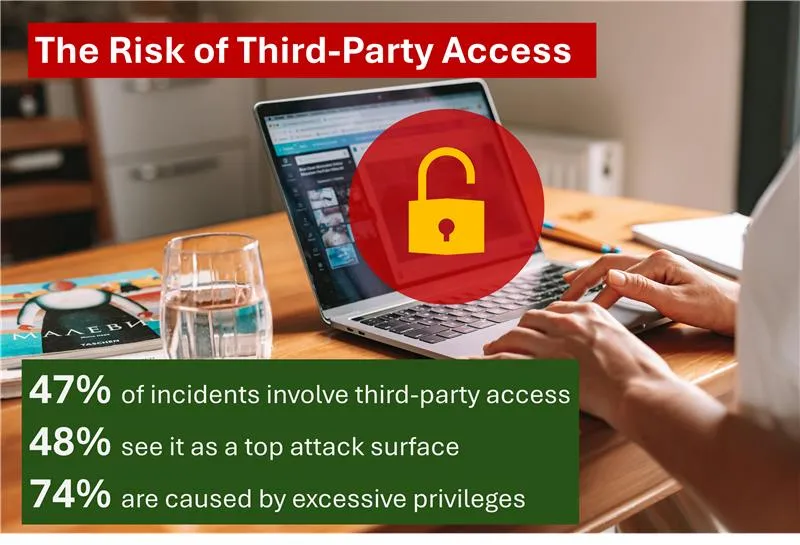
Recent industry research shows that 47% of organizations experienced a breach or cyberattack within a 12-month period that involved third-party access to their network. In the same study, 48% of respondents identified third-party remote access as one of the most common attack vectors.
Even more concerning, 64% of organizations expect third-party access-related incidents to continue increasing or remain at high levels. This indicates a structural issue—not a temporary spike in attacks.
Third-party access has become risky not because organizations rely on external users, but because access is often granted broadly and left in place long after it is needed.
How Attackers Abuse Legitimate Third-Party Access
According to the Sophos Active Adversary Report 2024, attackers overwhelmingly prefer entry points that already exist:
-
External Remote Services accounted for 63.16% of initial access techniques
-
Valid Accounts were used in 59.47% of cases
Rather than exploiting vulnerabilities, attackers increasingly log in through existing remote access paths using valid credentials.
Once an external user account, VPN session, or remote management channel exists, it can quietly become an entry point—often without triggering immediate security alerts.
The Real Problem: Excessive and Persistent Permissions
Most third-party access incidents are not caused by malicious insiders or compromised vendors. They are caused by permissions that are too powerful and remain active for too long.
Research shows that 74% of organizations attribute third-party security incidents to granting excessive privileged access.
In practice, external users are often given broad system or network access to complete a single task. When that access is not tightly scoped or promptly revoked, it becomes a standing invitation for abuse.
Three Common Failures in Third-Party Access Management
-
No Clear Inventory of Who Still Has Access
Only 46% of organizations maintain a complete list of third-party users who can access internal systems. This means many enterprises simply do not know how many external access paths still exist. -
Over-Privileged Access That Is Hard to Remove
Only 40% of organizations provide third-party users with least-privilege access, and just 37% have visibility into privilege levels across both internal and external accounts.
As a result, access granted for a single task often spans entire systems or networks. -
Limited Monitoring of Third-Party Activity
A 2025 study in healthcare environments found that 60% of organizations do not routinely monitor third-party access to sensitive data. Even when monitoring exists, 53% rely primarily on manual processes.
Manual oversight rarely keeps pace with the frequency and scale of third-party access.
What Effective Third-Party Remote Access Control Looks Like
Effective third-party access control does not mean blocking external users. It means
changing the access model.
A mature approach ensures that:
-
Access is time-bound
-
Permissions are task-specific
-
Activity is visible and auditable
-
Access can be revoked immediately
In this model, third-party users no longer receive permanent accounts. Access is granted per task , through dedicated connections that disappear once the work is done.
Why Time-Bound, Revocable Access Reduces Risk
Nearly all third-party access incidents share the same characteristics:
-
Access persists longer than necessary
-
Permissions exceed actual requirements
-
Activity is difficult to observe or revoke
By designing third-party access to be temporary, precise, and revocable, organizations reduce not collaboration—but the long-lived attack surface created by standing access.
OrpheLink: Enabling Controlled Third-Party Access Without Permanent Exposure
OrpheLink provides a secure connectivity foundation that allows organizations to establish controlled remote connections without exposing internal systems.
On top of this foundation, organizations can structure third-party access—whether for contractors, partners, or customers—into time-limited, auditable, and revocable workflows, without issuing permanent credentials or opening fixed network entry points.
With OrpheLink, organizations can:
-
Create task-based, time-limited access for external users
-
Restrict access to only the required systems and services
-
Revoke access immediately when work is complete
-
Reduce the risk of third-party access becoming a lateral movement path
This approach does not add another security layer.
It eliminates unnecessary long-term access at the architectural level.
Reference
-
Ponemon Institute × Imprivata (2024)
The State of Third-Party Access in Cybersecurity -
Sophos (2024)
Active Adversary Report 2024 -
Ponemon Institute × Sullivan (2021)
Managing Third-Party Permissions Is Overwhelming -
PMC (2025)
Third-party access monitoring study in healthcare organizations


