Secure Remote Access for Industrial: Why VPNs, Public IPs, and Open Ports Are Now a Major Security Risk
For distributed devices, OT, and IoT, remote access is now essential — yet VPNs, public IPs, and open ports turn them into fixed, discoverable entry points.
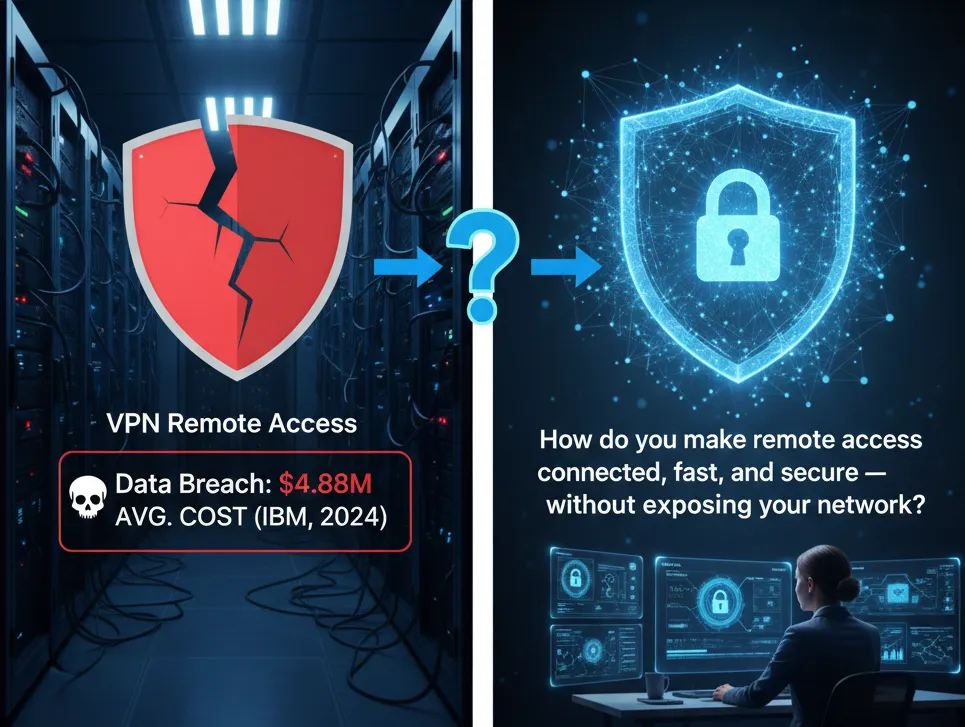
As companies deploy more servers, OT systems, machines, IoT devices, and remote sites, remote access has become part of daily operations. Engineers need to log in, troubleshoot, update, and recover systems from anywhere.
But most organizations still rely on VPNs, public IP addresses, and port forwarding to make that possible.
Those methods were never designed for always-on industrial and device networks. In practice, they create fixed, discoverable entry points that attackers can scan, probe, and eventually break into.
Remote access didn’t become more dangerous because of one bug. It became dangerous becauseexposed access became permanent.
How Attackers Actually Break in Today
When real-world breaches are investigated, the pattern is clear. The majority of attacks start through externally reachable systems.
Based on large-scale incident response data, the most common initial access methods are:
- Exploited vulnerabilities
- Phishing and stolen credentials
- Previously compromised accounts
- Brute-force attacks
All of them depend on one thing: a system that can be reached from the outside.
Whether it’s a VPN gateway, a remote management port, or a device with a public IP, if attackers can see it, they can target it.
What a Breach Really Costs
IBM’s 2024 Cost of a Data Breach Report shows how high the stakes have become:
- The average breach now costs $4.88 million
- These attacks take nearly 10 months on average to detect and contain
That means attackers don’t need to get in quickly. They just need time and a reachable entry point.
VPNs Are Still Everywhere — Even Though They’re High-Risk
If VPNs are so risky, why do companies still use them?
Because industrial systems don’t stop:
- Machines break and need immediate access
- Engineers are distributed globally
- Most sites don’t have on-site IT staff
So, organizations leave VPNs and remote access online all the time.
Unfortunately, that also leaves the door open for attackers all the time.
Real Companies Are Paying Price
Verizon’s 2024 Data Breach Investigations Report shows that VPNs and remote access systems — especially those without MFA — are among the most commonly exploited attack paths.
Recent incidents include:
- MGM Resorts, with over $100M in business impact
- Caesars Entertainment, which reportedly paid nearly $30M in ransom
These weren’t small companies with weak IT.
They were enterprises whose remote access became the breach path.
Secure Remote Access Is Also an Operational Advantage
Security is only half of the story.
In industrial and distributed environments, remote access also drives cost and up time. Research shows that modern remote maintenance models can reduce maintenance costs by 20–30% , while maintenance itself often represents 20–60% of total operating expenses.
That means secure, fast remote access directly improves both profitability and resilience.
What Modern Device-Grade Remote Access Looks Like
For machines, OT, and IoT, secure remote access must deliver three things at once:
Always reachable. Low-latency. Zero exposure.
That means:
- No public IPs on devices
- No permanently open ports
- No discoverable gateways
- Connections created only when authorized and only for the required system
- Real-time performance for control, monitoring, and troubleshooting
This is fundamentally different from VPNs.
How OrpheLink Solves the Problem
OrpheLink is built on a Zero-Trust, Zero-Exposure architecture designed specifically for devices and distributed infrastructure.
nstead of placing users into a shared network, OrpheLink creates isolated, on-demand tunnels:
- No single entry point — nothing attackers can lock onto
- Least-privilege access — each user, each device, each session isolated
- Zero-Trust authentication — every connection verified and controlled
- Direct paths — faster and more stable than VPN gateways
This allows engineers to work as if they are on-site, without exposing the network to the internet.
Learn more about OrpheLink: https://www.oprueba.com/
References
- IBM – Cost of a Data Breach Report 2024 https://cdn.table.media/assets/wp-content/uploads/2024/07/30132828/Cost-of-a-Data-Breach-Report-2024.pdf. Table Media
- IBM – Cost of Data Breach 2024 Overview https://www.ibm.com/think/insights/cost-of-data-breaches-business-case-for-security-ai-automation. IBM
- Verizon – 2024 Data Breach Investigations Report https://www.verizon.com/business/resources/reports/2024-dbir-data-breach-investigations-report.pdf. Verizon
- Google Cloud – M-Trends 2024: Mandiant Frontline Threat Analysis https://cloud.google.com/blog/topics/threat-intelligence/m-trends-2024. Google Cloud